
Beard Styles
Van Dyke Beard: The Pointed Chin, the Floating Moustache and the Gap
Short answer: A Van Dyke beard is a chin beard shaped to a point, worn with a moustache that does not connect to it, and with the cheeks shaved clean. The gap between moustache and chin beard is what separates it from a goatee. It is named after the 17th-century Flemish painter Anthony van Dyck and needs cheek shaving every day or two plus regular reshaping of the point.

Where the Van Dyke got its name
The style is named after Anthony van Dyck, the Flemish portrait painter who worked at the English court of Charles I in the 1600s. He wore a pointed chin beard with an upturned moustache, and he painted many of his sitters, including the king, with the same look.
The English spelling drifted to "Van Dyke" over time. The name stuck because the shape is so recognisable: a narrow pointed beard below the lower lip and a moustache that floats on its own.
The three parts you need to get right
Every Van Dyke is built from three elements, and adjusting any one of them changes the character of the style.
- The chin beard: runs from under the lower lip down to a point, usually 2 to 5 cm long, wider at the top and narrowing as it falls.
- The moustache: grown fuller than the chin beard; can be natural, trimmed straight or waxed with slightly turned-up ends.
- The gap: shaved skin at the corners of the mouth, typically 1 to 1.5 cm, separating the moustache ends from the chin beard.
Setting the gap
The gap should be wide enough to read clearly at conversational distance but not so wide that the moustache looks stranded. For most faces that is about the width of a fingertip at each mouth corner.
We cut the gap with a detail trimmer and finish it with a razor, then check that both sides sit at the same height. The gap tends to close as the moustache grows out sideways, so the ends of the moustache need clipping weekly to keep the separation. If you would rather the two pieces join, that is a goatee, and our goatee vs Van Dyke page explains the trade-offs.
Shaping the point
A clean point comes from tapering the sides of the chin beard, not from cutting the bottom to a V. If you snip only the tip, the beard looks clipped; if you narrow it gradually from the jaw down, it looks grown that way.
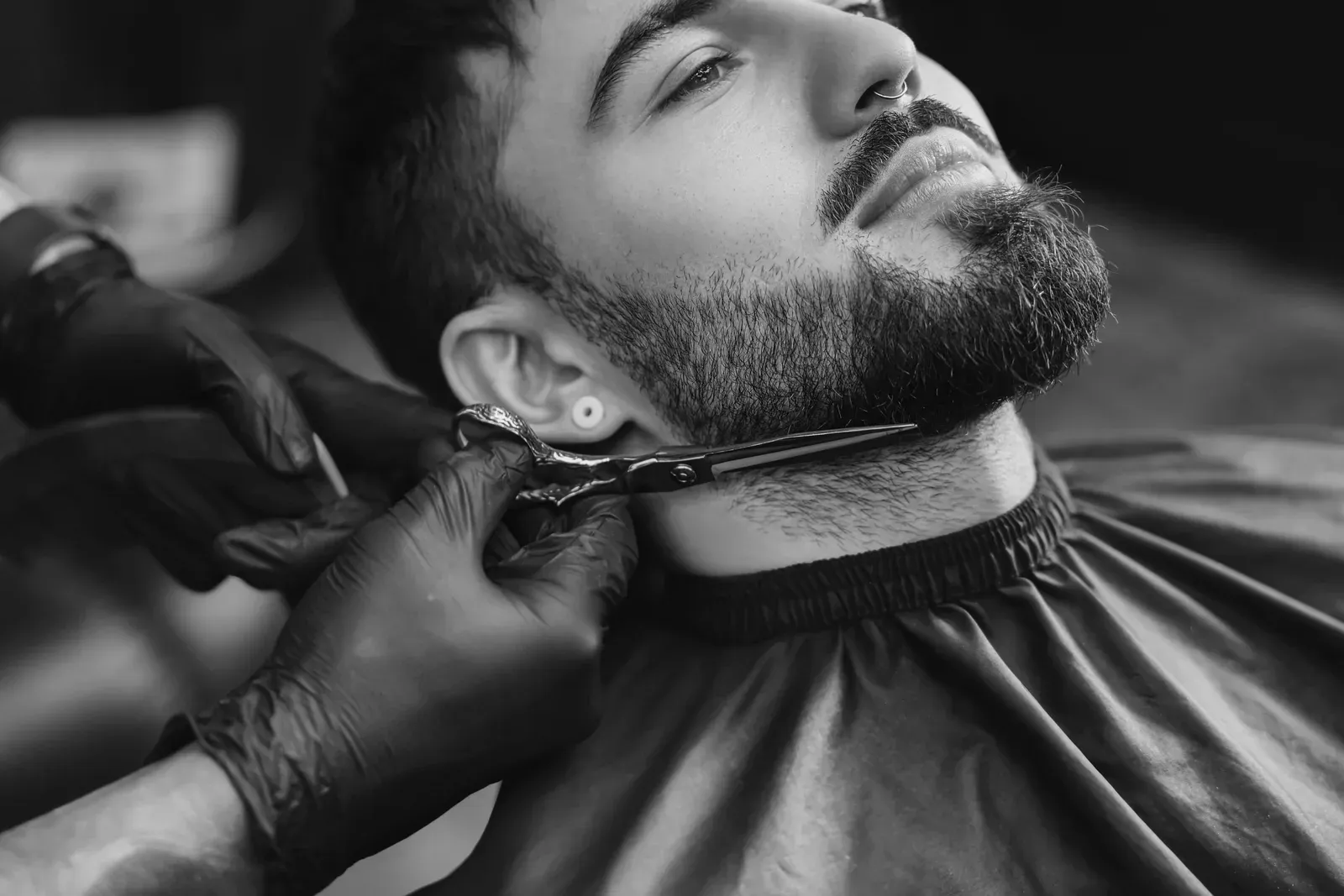
We brush the beard straight down, then take length off the outer edges with scissors, working toward the centre line so the point sits under the middle of the lip. Coarse or curly beards need a little balm to hold the point, which our beard balm guide walks through.
- Brush the chin beard straight down while dry.
- Pinch the centre and check where the natural point falls.
- Trim the outer edges on a diagonal toward that point, a little at a time.
- Check both sides in the mirror and in a phone photo from the front.
- Set the top edge just under the lower lip and razor the gap.
Faces that suit a Van Dyke
The pointed, vertical shape lengthens a round or square face and gives a soft jaw a focal point. It also works on heart-shaped faces with a narrow chin, because the beard adds weight exactly where the face narrows.
Very long, narrow faces usually do better with a rounded goatee, since the point adds even more length. It pairs well with short classic cuts and slicked or side-parted hair; a big textured top can overpower it.
Keeping it sharp between visits
Shave the cheeks and jaw every day or two, clip the moustache ends weekly to protect the gap, and brush the point into shape each morning. The chin beard itself only needs reshaping every 2 to 3 weeks.
A Beard Only + Lineup is the right appointment for that reset: we re-cut the point, re-open the gap and razor every edge. If the style is new to you, bring a reference photo so we can agree on how long and how pointed.
Van Dyke beard: common questions
How long does it take to grow a Van Dyke?
About 4 to 6 weeks of chin growth for a visible point, longer if you want a dramatic one. You can shave the cheeks from the start while the chin and moustache grow.
Do I need to wax the moustache?
No. A natural moustache works; wax is only needed if you want turned-up ends, which suit the classic painter look.
Is the Van Dyke the same as a goatee?
No. A goatee's moustache usually connects to the chin hair, while a Van Dyke keeps them separate and points the chin. See the goatee page for the connected versions.
Is a Van Dyke hard to maintain?
It is moderate. The daily cheek shave is quick, but the gap and point drift within a couple of weeks without attention.