
Barber Answers
How to Describe Your Hair Type to a Barber: The Words That Help
Short answer: To describe your hair type to a barber, cover five things: texture (fine, medium or coarse strands), density (thin, average or thick coverage), pattern (straight, wavy, curly or coily), growth (cowlicks, crown swirls, hairline shape) and scalp (oily, dry or sensitive). A sentence like "fine, dense, wavy hair with a crown cowlick and an oily scalp" tells a barber more than any photo.
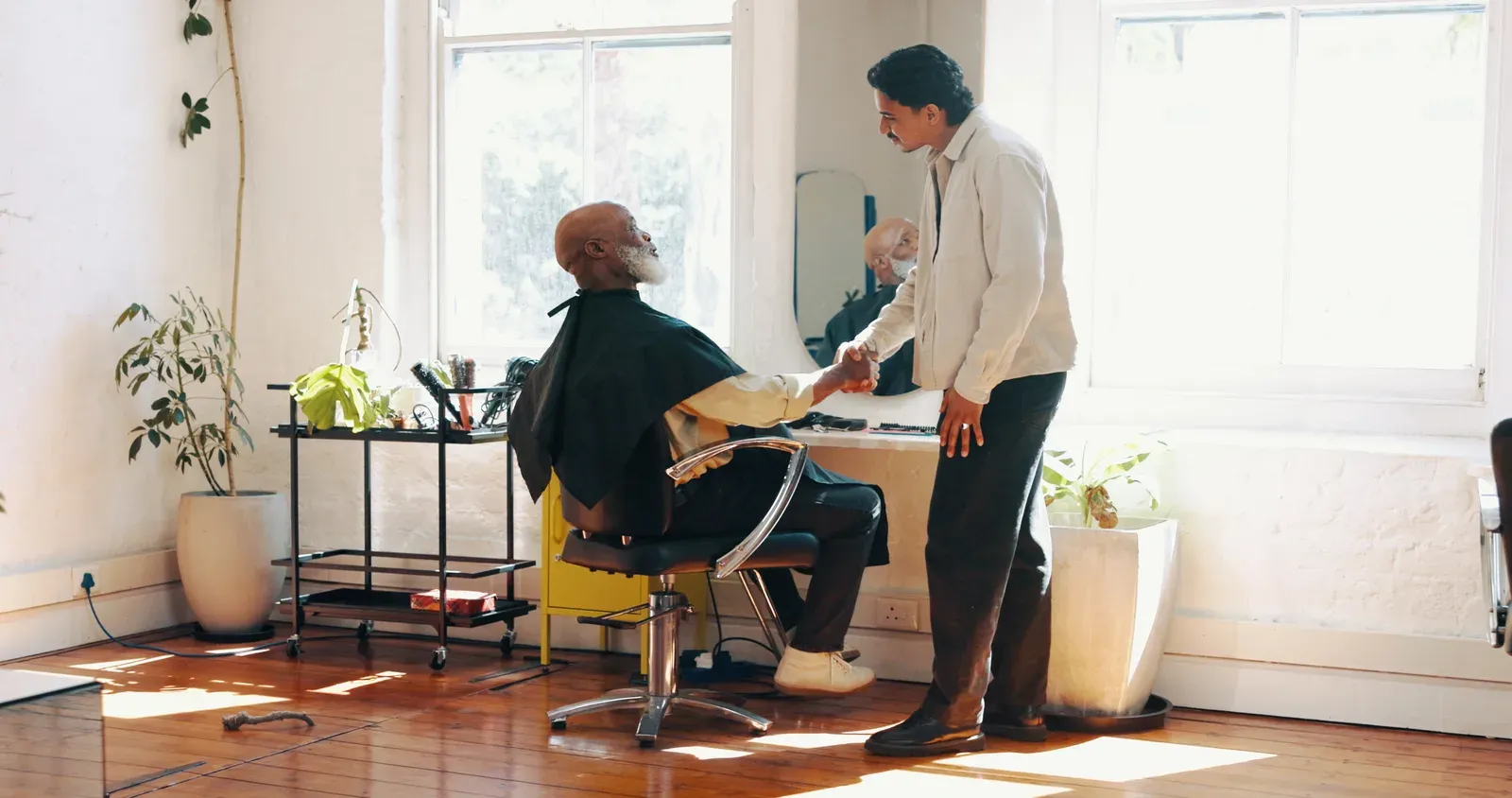
The five things a barber needs to know
Barbers judge hair by five qualities, and each one changes how we cut. Texture decides how short we can go before it sticks up. Density decides how much bulk to remove. Pattern decides whether we cut wet or dry. Growth patterns decide the direction we cut. Scalp condition decides how close we take the clippers.
You do not need perfect vocabulary. What helps is describing each quality in a word or two, plus how your hair behaves day to day. The table below gives you the words and a quick way to check yourself before your appointment.
| Quality | Words to use | Quick home check |
|---|---|---|
| Texture (strand thickness) | Fine, medium, coarse | Roll one hair between your fingers. Barely felt is fine; a distinct thread is coarse |
| Density (how many strands) | Thin, average, thick | Part dry hair on top. Scalp easy to see means thin; hard to find means thick |
| Pattern | Straight, wavy, curly, coily | Let it air-dry with no product and look at the shape of the lengths |
| Growth | Cowlick, double crown, widow's peak, uneven hairline | Wet it, comb it all forward, and watch where it splits or swirls |
| Scalp | Oily, dry, flaky, sensitive, bumpy | Notice how it feels a day after washing and after a close cut |
Texture and density are different things
The most common mix-up is calling hair "thick" when it is really coarse, or "thin" when the strands are fine but plentiful. Texture is the width of each hair; density is how many of them grow per patch of scalp. You can have fine, dense hair that looks full but will not hold height, or coarse, sparse hair that stands up well but shows scalp.
The difference matters in the chair. Fine, dense hair needs weight kept in so it does not go flat and wispy. Coarse, dense hair often needs bulk taken out so it does not puff into a triangle. If you are thinning, say so plainly. We would rather know, and our guide to haircuts for thin hair shows why it changes the plan.
Describing wave, curl and coil patterns
Many people use the number and letter system, from 1 for straight to 4 for coily, with A to C marking how tight the pattern is inside each type. Barbers understand it, but a plain description works just as well: "loose S-waves that go frizzy", "ringlet curls about the width of a marker", "tight coils with a lot of shrinkage".
Tell us how your hair looks dry as well as wet, because curly and coily hair can shrink to a fraction of its stretched length. That is why we often cut those patterns dry; see our guide to haircuts for curly hair and our page on coily hair for how it affects the cut.
Mention how your hair behaves, not just what it is
Behaviour tells a barber what your hair will do after you leave, which the chair cannot show. These phrases are more useful than any technical term:
- "It goes flat by lunchtime" suggests fine hair that needs texture and a lighter product.
- "The crown always sticks up" points to a whorl or an in-between length.
- "It puffs out at the sides when it grows" tells us to take weight out above the ears.
- "It frizzes in summer humidity" helps us choose between a shorter shape and a longer, heavier one.
- "My scalp gets bumps after a skin fade" tells us to leave a little length on the sides.
- "I air-dry and use no product" rules out any cut that depends on styling every morning.
Put it together in one sentence
The best descriptions are short and specific. Give the five qualities, add one behaviour and one goal, and the barber can fill in the rest by looking. For example: "Medium, thick, wavy hair, swirl at the crown, oily scalp. It puffs out at the sides after three weeks. I want it short on the sides with enough on top to push back."
Every cut at Markcutit starts with a consultation where we check your head shape, growth patterns and how you wear your hair, so we will confirm what you tell us with our own eyes and hands. Our page on what happens in a barber consultation walks through it, and the what to tell your barber journal post covers describing the style itself.
How to describe your hair type to a barber: common questions
Should I show my barber a photo instead?
Bring both. A photo shows the style you want, while the description tells the barber whether your hair can do what the photo shows.
What is hair porosity, and does my barber need to know it?
Porosity is how easily hair absorbs moisture. It matters more for choosing products than for the haircut, but mentioning that your hair dries very fast or stays wet for hours can help.
Should I come with my hair styled or unstyled?
Wear it the way you usually do, so we can see your daily shape. Heavy product is easily washed out, since every service here includes a hair wash.
What if I do not know my hair type?
That is fine. Tell us how it behaves and what bothers you about it, and we will explain what we see during the consultation.