
Style Comparisons
Side Part vs Slick Back: Direction, Length and Product
Short answer: A side part combs the hair sideways from a line placed above one eyebrow, so the top falls across the head in one direction. A slick back combs everything straight back from the forehead with no part, usually held with pomade. The side part works with shorter hair, suits most hairlines and reads as office-appropriate; the slick back needs more length, shows the whole hairline and looks bolder, especially in the evening.
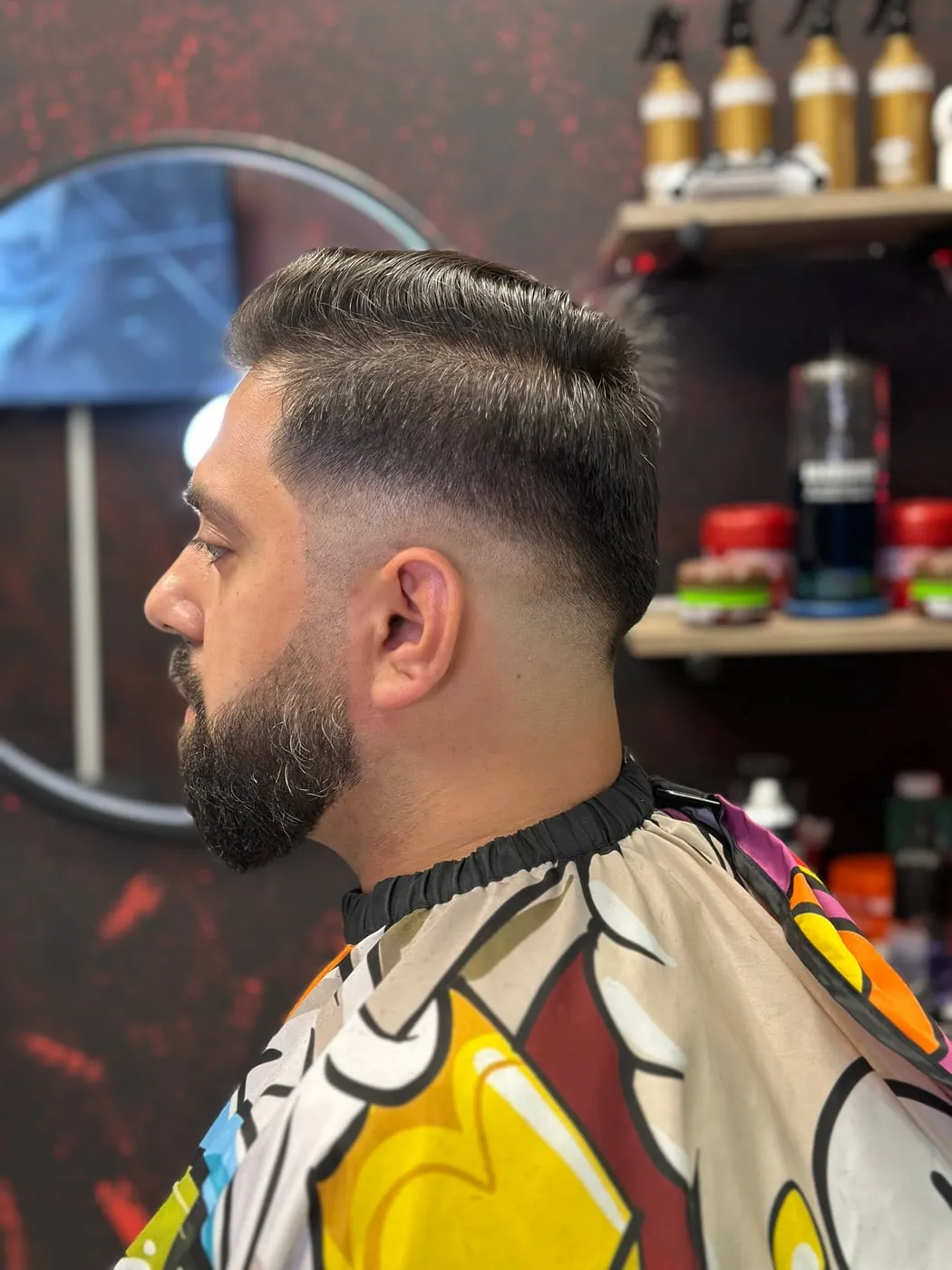
Where the hair goes on each style
Direction is everything with these two. On a side part, the top is split at a line, usually placed where your natural crown swirl wants it, roughly above the outer corner of one eyebrow. The larger section is combed across the head and the smaller section down toward the ear.
On a slick back, there is no split. The hair is combed from the forehead toward the crown and lies close to the head or with a little lift at the front. Every strand travels the same way, which is why a slick back looks so uniform when done well.
How much length and which product
A side part works from about 5 cm on top, and anything from 5 to 10 cm is the comfortable range. Shorter than that and the part line has nothing to separate. A slick back needs more, typically 8 to 15 cm, because the hair has to reach back over the crown without springing up.
Product follows the finish. A classic side part uses a light cream or water-based pomade for a neat, low-shine look, or a matte clay if you want it softer. A slick back relies on pomade for control and sheen. Our pomade vs wax vs clay comparison explains which hold level each style needs.
The comparison at a glance
Here is a quick reference for the practical side of both styles.
| Side part | Slick back | |
|---|---|---|
| Direction | Across, from a part line | Straight back, no part |
| Top length | 5 to 10 cm | 8 to 15 cm |
| Typical sides | Taper, low fade or scissor-cut | Undercut, fade or longer scissor sides |
| Product | Cream, light pomade or clay | Medium to strong pomade |
| Shine | Low to medium | Medium to high |
| Hairline on show | Partly covered by the sweep | Fully visible |
| Morning time | About 2 to 3 minutes | About 5 minutes with a dryer |
Hairlines, cowlicks and crowns
Your hairline is often the deciding factor. A slick back pulls everything away from the forehead, so receding temples or a widow's peak are fully on display. That can look great if you own it, but it will not hide anything.
A side part is kinder to thinning or uneven temples. The sweep across the forehead covers one corner, and placing the part on the side with the deeper recession keeps it out of the spotlight. Read haircuts for receding hairlines for more on that choice.
Cowlicks at the front usually push hair to one side, which makes them natural partners for a side part and a fight for a slick back. A double crown can split a slick back at the back of the head; a side part hides that better too.
Office, evening, or both: making the choice
For the office, the side part is the steady choice. It reads as groomed and conservative, it survives a toque on the commute with a quick comb, and it pairs well with a tapered or low-faded side. It is the cut we see most for job interviews and weddings.
For evenings and events, the slick back makes more of a statement. With a fresh undercut or fade and a bit of shine, it looks deliberate and polished, especially with a suit.
Want both? Grow the top to around 10 cm and keep sides that suit either style. Plenty of men wear a side part on weekdays and comb it straight back for weekends; a slick back with a soft side sweep is a common in-between.
Booking either style at Markcutit
Tell us how you want to wear it most of the time, because we cut the top differently: a side part is weighted to fall across, a slick back is graduated so it lies flat as it travels back. If you want a hard part, a razor line at the part, say so during the consultation.
Both are booked as Haircut Only and shaped with scissors on top; see the scissor cuts service. Style pages for the side part and the slick back go deeper on each.
Side part vs slick back: common questions
Which side should my part be on?
Follow your natural crown swirl or wherever your hair falls when towel-dried. We can check it in the chair in seconds.
Does a slick back damage your hair?
Combing back with product does not damage hair on its own. Wash product out regularly and avoid very hot blow-drying, which can dry the ends.
Can wavy hair do a slick back?
Yes, with a stronger pomade and a blow-dryer to relax the waves. A looser, textured slick back also suits wavy hair and needs less product.